
Health
Portuguese water dogs are a breed that is faced with several health issues that all breeders should be aware of it. Currently in Slovenia only a few genetic testings are mandatory (besides hips x-rays), but those are not the only major ones appearing in our breed.
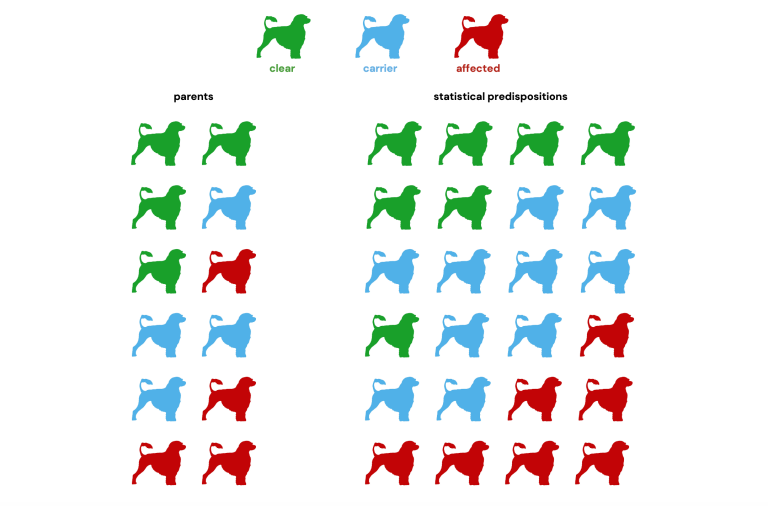
It is important to know if the dog is clear, carrier of said issue of if they are affected, as only with that smart decisions can be made and with it breeders can be sure that their puppies won’t be affected. Below you can see what statistical predispositions are having pairing of different combinations for issues that are inherited recessively.
Progressive Rod-Cone Degeneration (PRA-prcd)
PRA-prcd is a late onset, inherited eye disease affecting many breeds of dog. PRA-prcd occurs as a result of degeneration of both rod and cone type Photoreceptor Cells of the Retina, which are important for vision in dim and bright light. The rod type cells are affected first and affected dogs will initially have vision deficits in dim light (night blindness) and loss of peripheral vision. Over time affected dogs continue to lose night vision and begin to show visual deficits in bright light.
Early onset EO-PRA
This disease is also caused by degeneration of retinal photoreceptor cells which are used for vision in both dim and bright light. Symptoms of the disease present early with vision issues becoming apparent at approximately 1 year of age. The disease gradually progresses with significant vision loss by approximately 4-5 years of age.
Gangliosidosis (GM-1)
Puppies affected with GM1-Gangliosidosis develop nervous system manifestations including ataxia, seizures and changes in temperament. Dogs affected with GM1-Gangliosidosis rarely survive beyond 6 months of age.
Juvenile Dilated Cardiomyopathy (JDCM)
JDCM is an inherited fatal disease in young Portuguese Water Dogs that is caused by a recessive gene. Puppies affected with JDCM die suddenly or with very little warning usually between the ages of six weeks to seven months old. The signs and symptoms of JDCM include a 12 to 48 hour onset of loss of appetite, decreased energy level, vomiting, and difficulty breathing. Some pups have no physical signs or symptoms at all, may just collapse and die, or are found dead by the breeder or new owner. At this time, there is no known cure or treatment but there is a way to prevent producing JDCM affected puppies.
Microphthalmia (MOS-PWD)
The disease is characterized by microphthalmia and other ocular abnormalities, such as persistent pupillary membranes, glaucoma, retinal degeneration and cataracts. Other signs may include stunted growth, decreased platelet counts, anemia, and possibly behavioral abnormalities.
For all the diseases mentioned above genetic tests are available.
Another issue that is persistent in our breed is hip dysplasia. It is a painful condition that causes one or both hip joints to develop abnormally while a puppy is growing. Hip dysplasia causes pain, swelling and eventually arthritis. Dogs can inherit hip dysplasia from one of their parents but many times there is also environmental cause to it. It is detected by doing a set of X- Rays of the hips. FCI grades the hips as HD A – E, A being without any signs and E showing sever signs of it.
While all theissues mentioned above are health related, there is one issue that affects only the coat type and this is called improper coat (IC). Dog affected with this has the coat not typical to the breed and even though it does not impact the health, intelligence and personality, this dog does not conform to breed standard. Improperly coated dogs and puppies may have double coat that sheds, shorter coat, etc.